Showing posts with label 4 stars. Show all posts

Tuesday, July 12, 2011

The Tiger's Wife: A Novel


I didn't set out to read a book about the death of a grandparent so soon after my own grandma passed away, but Tea Obreht's debut novel piqued my interest. The Tiger's Wife is equal parts fable, memory and nostalgia.
Natalia is a young doctor in her imaginary Balkan country, war torn and ravaged. On a mission to "the other side" she learns of her grandfather's passing and spends the next few days remembering him while she attempts to find the belongings he had on him when he died, including a copy of The Jungle Book Natalia remembers well. Natalia carries her memories of her grandfather, but also two stories her grandfather told her: one, the story of the Deathless Man and two, the story of the Tiger's Wife. Both recall the best writers of magical realism.
Natalia struggles with fulfilling her professional role and being with her grandmother to mourn. I was able to empathize; contemporary society doesn't allow time for grieving, or death. But this book reminded me that I can take my time, that the memories I have of my grandma will stay with me, and I can recall them at will, just as Natalia did.
The Tiger's Wife is remarkable in part because of Obreht's young age and for that I'm thankful. I look forward to many more novels from her.
4/5 netflix stars

Monday, June 20, 2011

Claire DeWitt and the City of the Dead


In elementary school we participated in BookIt, which was a program where we set a goal of a number of books to read and when we reached that goal we'd get a coupon for a personal pan pizza from Pizza Hut. It never took much for me to be motivated to read, but getting that pizza was pretty special. A few weeks ago I got an email from the library that four books I had requested were ready to pick up. Panic! How would I read so many books? Obviously I need to motivate myself with pizza, so from here on out, it's a book a week!
Fortunately Claire DeWitt and the City of the Dead by Sara Gran was both short and a mystery-- a perfect quick read. Claire is hired to investigate the disappearance of man's uncle in Post-Katrina New Orleans. Her detection methods are based on her mentor, Constance, as well as a book by Silette called Detection. Her methods also include copious amounts of booze and prescription and non-prescription drugs. Besides her actual case, several other "mysteries" are alluded to, making a strong case for future books.
New Orleans is portrayed as fairly post-apocolyptic in this book, not so different from Zeitoun. It's the perfect setting for crime noir and Gran's writing is spot on. A favorite quote, that represents a colleague, but could refer to many inhabitants of New Orleans: "Some people, I saw, had drowned right away. And some people were drowning in slow motion, drowning a lit bit at a time, and would be drowning for years. And some people, like Mick, had always been drowning. They just hadn't known what to call it until now. "
4/5 Netflix stars (and one book closer to my pizza).

Thursday, February 17, 2011

The Woman in White


How many English novels set in extravagent estates in the mid 1800s have made you wonder, "how come these people don't have jobs?"  Sure there's the nannies and the pastors and the family attorneys and all the various servants, but most of the gentlemen and women prance around waiting for mail that tells of their beloveds also prancing around waiting for mail.
The Woman in White by Wilkie Collins is a bit different.  The story opens with Walter Hartwright accepting a position as an art teacher for a couple of country estate living daughters of a nervous wreck of a gentleman.  En route to the new job, he runs into a distraught woman in white who needs directions to London and assurance that Mr. Hartwright will forget about her. He mentions the interaction to his new pupils, one, Laura, who bears astonishing resemblance to the Woman in White. And from this the stage is set for one of the first mysteries published-- and piles of letters that are sent back and forth between estates with replies that come quicker than our email of today.  Collins was a trained lawyer and goes into detail about financial and inheritance law of the time-- important if you are just going to live off interest.  A couple of notable characters are introduced along the way-- Sir Percival Glyde who is both obsequious and nervous, Count Fosco who is devious, and a slew of passerby who make the book a quick read.
Ultimately the denoument was well executed, but long! Like, 100 pages long. Other than that it was as good as the Millenium series for sure.
netflix stars: 4/5


Monday, January 17, 2011

Zeitoun and The Lacuna


If Dave Eggers wrote the original Heartbreaking Work of Staggering Genius, he's followed it up as an adult with even more heartbreaking works: What is the What a few years ago and Zeitoun in the past year or so.  It might be too soon for some to read a non-fiction account of a family's post-Katrina life in New Orleans.  If that family is Muslim, it might put anyone over the edge.  After sitting on my shelf for a year, I picked it up only because it's the current book club pick. I didn't know if I was ready to cry through the entire story.
The cover is an illustration, but could be any number of photographs that came out the days following the hurricane and levee breaks...a man in a canoe, gliding through the streets.  The man is Abdulrahman Zeitoun, a Syrian immigrant who owns a contracting business along with his wife, Kathy.  Eggers writes about their lives in a journalistic fashion.  He fills in the day-to-day life of a hard working father of five with brief backgrounds of Zeitoun's life in Syria and Kathy's life as a younger woman in New Orleans (including her decision to convert to Islam).  Kathy and Zeitoun watched the weather reports leading up to Katrina's attack on the gulf coast much as we all did, but most of us didn't have to decide weather or not to evacuate and most of us didn't have to come home to houses completely inundated.  Even fewer of us chose to stay in New Orleans, as Zeitoun did, witnessing trapped neighbors, looting, interrogations by the law and the lawless.
The Lacuna by Barbara Kingsolver is a different account of so called law in the guise of public safety but 50 years earlier.  It's a fictional account of William Harrison, an American who grew up in Mexico and ended up working for Frida Kahlo and Diego Rivera as a kind of jack of all trades-- sometimes plaster mixer, sometimes cook, sometimes confidante to Mrs. Kahlo.  Frida has become such an iconoclast that it was hard to believe her conversations with Harrison.  I had trouble seeing where Kingsolver was going at times-- why so much background on Harrison's mother? It was a 600+ page book and at times I felt like I wouldn't make it through.  But then there was a turning point.  When Kingsolver devoted the second half of the book to Harrison as popular author and quiet bachelor in a small Southern town, the story became compelling.  Kahlo and and Rivera are too big to compete with and Harrison deserves to stand on his own, and he does.  In a short time we learn that he is targeted as a Communist, quotes from his fiction are attributed to him, out of context, and no matter what, the US government will bring him down.  Kingsolver is a bit heavy handed in her allusions to current government control and persecution (read Zeitoun) but Harrison is a complete and sympathetic character. I felt the same helplessness with Harrison as I did with Zeitoun.
These may not be the best reads for conspiracy theorists...or maybe they're the best reads for all of us. 5 and 4 stars respectively.

Wednesday, August 25, 2010

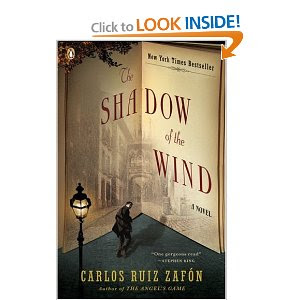
The Shadow of the Wind


It's been rainy the past several days, even though we've had an overall sunny summer. When we were growing up, my sister and I would go to the neighborhood pool almost every afternoon. Unless it was raining and then we would go to the library and check out as many books as we could carry.  The Shadow of the Wind by Carlos Ruiz Zafon reminded me of a book I would have checked out on one of those rainy days.  Our hero, Daniel, is taken to the Cemetery of Forgotten Books at a young age by his father, and encouraged to "save" a book.  He chooses The Shadow of the Wind by Julian Carax and begins a lifelong love with the rare book, it's author and the women who also love the book and it's author.
This was a really pleasant book-- it read quickly, had memorable and well developed (male) characters, provoked nostalgia and was a good reminder of why we love to read novels.
4/5 netflix stars

Wednesday, July 28, 2010

The Show I'll Never Forget and The Girl Who Played With Fire


When I moved to Boston in 1996, I was thrilled with all the shows I could see-- musicians and bands that wouldn't come anywhere near Wichita regularly played in Boston and Providence.  I could see The Violent Femmes, or The Lemonheads, or the Mighty, Mighty, Bosstones!
Once we were old enough to drive, my friends and I would see any show that came through The Cotillion and would venture to Kansas City and Tulsa as well.
The Show I'll Never Forget edited by Sean Manning is collection of writers who recall, obviously, the show they'll never forget. Some are first concerts and some are just really iconic concerts (Woodstock).  Some read like braggarts (so, yeah, I saw Hendrix...) and some are extremely personal (a high school benefit concert for an ill student).  The shows run the gamut from Patti Smith to Nirvana, from Nina Simone to the Beastie Boys.  In some cases, I would be just as mesmorized to see the writer (Jennifer Egan, Chuck Klosterman) as the concert (The Stones, Miles Davis, James Brown!).  I was disappointed by only a few essays- by and large each writer evoked a time and place (watching a Red Sox game with The Pogues at Fenway).
Two shows came to mind for the Show I'll Never Forget.  For my 18th birthday my mom got me four tickets to see The Cranberries in Kansas City.  When I look at the pictures from that trip, I remember how excited myself and my three friends were and also think what a great mom I have. She drove us to KC and took us to an early dinner, then waited in the parking lot during the whole show while we were inside (well, outside).  I know concerts are about smoking pot, but we were good kids, and since it was my 18th birthday I did two things: I bought a legal pack of cigarettes and I registered to vote at the Rock the Vote tent (the voting stuck, the smoking didn't).
The second show I really remember was seeing Pavement in 1997.  I'd just finished my first year of college and my friend Caron and cousin Jenny came into Boston and we saw them at the Roxy.  We were SO EXCITED!!  I remember Jenny had to use a fake id to get in, because she wasn't 18 yet and I remember the opening band sucked (Shudder to Think) and I remember just being thrilled that they played everything I wanted to hear.  We could see them pretty close and I was just in love.
 
I read the 2nd book in Stieg Larsson's Millenium trilogy-- The Girl Who Played with Fire.  You're either going to read this book or you're not (or you already have) and it's no use giving details.  Needless to say it was captivating and I can't wait to read the third and final book.
 
netflix stars: 4/5 and 5/5

Sunday, December 20, 2009

A Walk In The Woods


My mom liked to say that from Kansas, you could get to somewhere fun in a mere 12 hour drive.  The beaches on the Gulf were 12 hours to the south, the mountains 12 hours to the west, and deserts and cacti 12 hours to the southwest.  We spent many summers in Colorado or Santa Fe, and most vacations involved some rustic cabin living and lots of hiking.  We had our favorite trails-- the Alpine Trail near where we stayed in Buena Vista, CO and the ski basin in Santa Fe.  But these trails would represent just a centimeter of the 2,200 miles of the Appalachian Trail from Georgia up to Maine.  In the mid-90s Bill Bryson and his friend Steven Katz decided to hike the AT over the course of several months, and A Walk In The Woods is Bryson's record of that adventure.
I started this book as part of the Emergency Holiday Challenge and remembered Steph loving it and was even told by someone in my yoga class how funny it was.  And while it was funny, it was also wistful and kind of sad.  Bryson would intersperse details of the hike (lots of walking, lots of trees) with facts about the AT and the environmental changes.  We've all heard about the demise of the passenger pigeon, and the relatively quick fell of the American Chestnut trees...Bryson lectures us just to the point of depression and then says, "back to the trail!"
Even though this book is just about 10 years old, at times it felt dated.  Bryson writes with disdain about people to bring modems hiking so they can share stories from the trail (um, that would be blogging) and writes with amazement that some people have brought satellite tracking devices (what we now know as GPS!).  Every few days they arrive at a small town where they check in with their families from payphones.  Cell phones were not rampant yet.
2,200 miles is a lot of hiking and without giving anything away, a six-mile day hike on a trail of woods, streams and mountains maybe gives you the same idea as 6 months of the same.  Day hikes let you get back to the relative warmth of a cabin (and maybe access to some soothing hot springs) by 6 pm.  Nevertheless, I feel lucky that we have the luxury of wilderness to hike in, that despite the extinction of species, we generally value unspoiled nature.
4/5 netflix stars

Thursday, November 19, 2009

A Gate at the Stairs


The past seven or eight years have brought a host of post-9/11 novels. Some are good, some are bad. I like that most maintain the delicate balance of public tragedy and a new world order with people who still need to live their lives. A Gate at the Stairs by Lorrie Moore seems to almost privatize the public and publicize the private.  So I've been processing it the past couple days and am still not sure what I think.
Tassie is the protagonist; a good, Midwestern girl entering her sophomore year of college as 9/11 takes place.  She takes it in stride, instead worrying about what any 20 year old would worry about-- finding a job and finding a boyfriend.  She takes a job as a nanny for a bourgeois yet very liberal older couple who are adopting.  Sarah and Edward bring Tassie along to meet various birth mothers and finally end up with a mixed race 2-year old.  From here the story takes off: Sarah becomes a mouthpiece for every liberal stereotype-- she worries about Emmie facing racism and so forms a support group of like minded (sometimes) parents.  But as Tassie brings Emmie everywhere, she bears the brunt of public reaction-- is she the young mom?  The baby daddy must be black (bringing positive and negative reaction).  She absorbs it and meanders between her Sufism class and her boyfriend's (of dubious heritage and ethnicity himself) house, all the while forgetting that her younger brother is threatening to join the army after graduating high school.
A Gate at the Stairs is dialogue rich and Tassie's carte blanche viewpoint makes us realize our culpability with so many pre and post-9/11 social issues.  It's a compelling read and a great way to get back into novels after reading so much non-fiction.  It raises questions without providing answers. 
This is a vague review...readers and comments welcome!
Netflix stars: 4/5

Friday, November 6, 2009

The Thoreau You Don't Know: What The Prophet of Environmentalism Really Meant


Having friends whose babies are learning to talk, I asked my mom what my first word was.  Her response? "Thoreau".  You might think from this that my parents were hippies, that they were social dissidents or that I was born to recluses in a cabin in the woods.  Or you might think I listened to "Walden" nightly while in my mom's womb.  Whatever you might think, it's probably wrong.  And that's why Robert Sullivan wrote The Thoreau You Don't Know: What The Prophet of Environmentalism Really Meant.  He wants to expand on the Thoreau we all know from reading excerpts of Walden in high school.  He wants to prove that Thoreau wasn't just an old curmudgeon.
The Thoreau You Don't Know is a very accessible biography of a now lauded American citizen.  Sullivan tells us that Thoreau was critical of society while also striving to make it better.  He came from a family of hard workers and was a successful business man (pencils!)-- not a lazy good-for-nothing bumming around in the woods.  He aimed to be a writer and a poet while knowing that it might not pay the bills-- and so supplemented his writing by doing chores for Emerson, teaching and even bringing in income from his bean crops at Walden.
Sullivan's love for Thoreau became my love for Thoreau.  I can't help but smile knowing that all his actions and his life's work were deliberate-- even if unpopular at the time (after his death a friend said he loved Thoreau, but didn't like him).  He only lived to be 45, but did so much-- and often did it with a sense of humor.  Sullivan reports that he spoke with humor and irony.
We know the Thoreau who coined the term "succession" and the Thoreau who inspired Dr. Martin Luther King.  But The Thoreau We Don't Know was also a product of his time-- a time of progression and societal change.  Sullivan shows us that Thoreau.
I give this book 4/5 netflix stars. 
And if you're curious why my first word was Thoreau?  Thoreau was the name of our family dog!

Thursday, August 20, 2009

Rag and Bone: A Journey Among The World's Holy Dead


A little over a year ago, my sister Liz took me to the Basilica of the National Shrine of the Immaculate Conception. It's off the beaten track of the other monuments in DC and there's nothing much else out there. But we were curious and we like churches. The Basilica was immense and sparkling and to two non-Catholics, daunting. We opted for the tour. Our guide explained statues and histories of saints and took us into special alcoves and soon we all lined up to view the relic. Maybe it was a bone fragment; I can't recall. But we all moved in a circle to get a glimpse.

Peter Manseau tells similar stories of viewing relics the world over in Rag and Bone: A Journey Among the World's Holy Dead. His interest is that of a layperson, like myself. He's not someone who has a strong religious attachment to the relics he visits themselves, but is curious about how the affect so many people, and on some level, are common to all the world's religions. He visits India, Israel, Pakistan, Syria and interacts with Jews, Catholics and Muslims. He describes a brief history of each of the relics he visits-- most are dubiously authentic but have at any rate suffered indignities and brutalities post mortem that sometimes exceed the violence experienced by the living person. And he usually speaks with the caretakers of the relics and/or shrines. He meets a nun whose personal life was marked by so many violent accidents that she felt compelled to turn to religion and the saint whose remains her convent now hosts. He met a family who for generations had been guarding a holy tooth in Kashmir, but who had lost their legacy through politics; Inidian guards now hold the keys. He met a scientist whose life work it has been to verify (or not) the remains of Saint Joan of Arc. He claims he is not spiritual, yet he reveres her bones with a fervor usually reserved for the most pious.

Mr. Manseau comes to realize that the relics are more than just a spritual connection-- in Sri Lanka they provide jobs-- helping the economy informally (tours) and formally (the requisite gift shop), in France, local pride unites a community and in Syria, children get to practice their English with tourists.

Mr. Manseau journeys the world with curiousity and respect. For him, it's a strictly personal exploration as much as an means to discovering the history of relics. His message is subtle-- living people and living history is more important than the dead.

For myself, the Basillica was beautiful, but maybe too beautiful. It was hard to for me to reconcile the ostentatious gilt with the suffering experienced by the saints featured. I appreciated Mr. Manseau's journey.

Netflix rating: 4/5 stars

Monday, January 5, 2009

The View From Castle Rock


I was afraid I'd picked a dud for book club. Our turns roll around every 6-8 months or so and so I've usually thought of something that I think everyone will enjoy or benefit from but that they wouldn't necessarily pick for themselves. I hadn't given it too much thought so picked A View From Castle Rock by Alice Munro, a book my mom had loved and passed along to me. I'd tried it awhile back but couldn't get into it so put it aside. I thought having the book club read it would be good incentive. And ultimately it was, but it was a rough time getting there.
Ms. Munro bases these loosely connected short stories on her family's emigration from Scotland to America. She starts with a very great grandfather's journey in the 18th century by boat to Canada. Following stories tell of her pioneering family taming and settling woods. Husbands, wives and children die and someone passes the stories along orally or in journals and letters. Ultimately the stories become more connected to Ms. Munro: her parents meeting and raising fur foxes, her own forray into love and employment and finally her own brushes with death of those most close to her.
About half way through the book I figured out why my mom loved it, and why I ultimately would love it. It's my family history. And just as Ms. Munro's interest in her family history was piqued as she grew older, my interest in the book piqued as generations passed and I started to feel connected to them. I understood the quite austerity of this family of Presbyterians and identified with them. I smiled at their value of education, but not at the expense of hard work.
My grandma happened to call right after I'd finished the book, saying she had been looking through pictures and letters and thought of me. I immediately told her of A View From Castle Rock and said I'd send it to her. It's our kind of story.

Sunday, September 21, 2008

Later, At the Bar


When I'm not reading books off my shelf, I sometimes refer to the New York Times list of notable books. It's nice to have a short list of well reviewed books that may deviate from what I would normally choose to read. A "novel in stories" called Later, At the Bar, by Rebecca Barry, however, appealed to me immediately for it contained two of my favorite things: short stories, and a bar.
Based in a small town in upstate New York, each story chronicles the lives of a small group of down and out townies, with blue collar jobs, who usually end up at the bar, Lucy's. They sometimes aspire to something more (a longer marriage, a successful job), but know no matter what they live in a community where they are accepted without regard to their shortfalls. The cast includes Harlin and Cyrus Wilder, hard partying twins for fall hard for cheating women. There's Grace, one of the cheating women who marries Harlin. Linda writes an advice column for some small papers, and usually drinks vodkas while composing her answers. My favorite is Elizabeth Teeter, a woman whose husband recently left her for another man. She admits to being annoyed by people who talk to their pets, but once her husband leaves, she finds herself having conversations with her cat, Roger.
Ms. Barry does a wonderful job of giving human qualities to otherwise unsympathetic characters. The stories can be read separately, but taken as a whole, they really provide a snapshot of some sort of Everytown, USA. The stories read kind of slow at times, but otherwise I enjoyed them, and will give Later, At the Bar 4/5 netflix stars.

Sunday, June 15, 2008

The Wind-Up Bird Chronicle


I have fond nostalgia for the early 90s-- my generation saw the end of the Cold War and the crumbling of the Berlin Wall. My mom learned that JFK was shot while she was in typing class, but when I was in typing class, I pondered "Who Killed Laura Palmer?" Indeed, the 90's were a Lynchian wonderland. I watched and analyzed each episode of Twin Peaks the way people today watch and analyze Lost. So reading The Wind-Up Bird Chronicle by Haruki Murakami triggered the part of my brain that lusts after crazy David Lynch.
Murakami creates a "real" world in parallel with a credible dreamlike "alternate" world. As in Kafka On The Shore, the protagonist is semi-alone, and searching for the meaning of his life. A cat is once again the catalyst for the search. Lynch created bizarre characters who were just accepted (the Log Lady) and Murakami does the same. The Kano sisters appear out of nowhere and dress as if from a different decade. They have psychic powers that are only slightly questioned. More new characters are introduced to the protagonist Mr. Okada than I might meet in an entire year; and Mr. Okada doesn't work and rarely leaves the house! A woman Nutmeg and her son Cinnamon become benefactors for Mr. Okada, and a Lieutenant Mamiya relates a distant past that turns out to be quite relevant to Mr. Okada's present, and likely his future.
The Wind-Up Bird Chronicle was long. It's no secret I love a short and well edited book, but somehow this book kept me engaged, because I knew in the end all the storylines would somehow come together. And they did. Sort of.
I give this book 4/5 netflix stars.
Wine pairing: Casillero del Diablo Sauvignon Blanc. Translates as "Cellar of the Devil", not unlike the ominous wells which feature in The Wind-Up Bird Chronicle. Also, at $7.99, a nice price for unemployed folks who have time to sit in wells, like Mr. Okada. And also for people who have time to take notes on every episode of Twin Peaks.

Friday, May 30, 2008

THE SILVER CHAIR- by c.s. lewis

The book continues the story of Eustace, and introduces his friend and classmate Jill Scrubb. They are brought to Narnia just in time to save them from a brutal beating from fellow classmates. Aslan explains that Caspian's son, Prince Rilian, had been kidnapped 10 years ago, and must be found before his father dies. He gives Jill four signs to follow in order to find Rilian, and off they go. With the help of a marsh-wiggle named Puddleglum, they journey through the giants' kingdom and into underland to find an enchanted Prince Rilian kept captive by the Lady of the Green Kirtle. After a battle, they're successful in their quest, and return to the castle just in time.
I liked the addition of a new main character. It was done much more smoothly (with Eustace, who appeared before) than in The Horse and His Boy.
Netflix rating? 4/5 stars.

Monday, May 5, 2008

Run


I tend to be highly critical of books and movies about Boston, always looking for inauthenticity. The Afflecs are always, "We're from Bahston, we've got the accent." And I'm like, "No, you're from Cambridge. But thanks for advocating for the larger Boston metro area." Authors tend to overstate Boston landmarks, making egregious references to neighborhoods like Roxbury, Dorchester and Charlestown. In Run, Anne Patchett made mostly skillful remarks about landmarks, noting the Citgo sign on a drive to Cambridge, and referencing various T stations. In fact, knowing the city and knowing how small it really is and how various locations fit together, is key to the story.

A prominent Boston Irish politician and his wife adopt two African American children after they couldn't have any more children (suspend your disbelief that such a mixing of races could happen 25 years ago in Boston) and Run takes place over the 24 hours after one of the grown sons is nearly hit by a car, save a strategic push from a woman who turns out to be his and his brother's biological mother. The woman's young daughter, Kenya, witnesses the event and over the course of the night details how she and her mother know the family, and how they have been secretly keeping tabs on the boys for years. This sort of anonymity and close proximity is so possible in a city like Boston. Save the transient college students, Bostonians live here for generations and the city is small enough that you can run into the same people over and over again. Blue blood Boston Brahmins live mere blocks from the city's poor in public housing.

Besides checking on the accuracy of references to my city, I also hold close a carefully edited book, one which keeps the economy of words in check. Fortunately this book held up on both accounts. I'll give it 4/5 netflix stars.


As a nice aside, my mom went to a reading by Ms. Patchett and had this book signed for me!

Sunday, April 6, 2008

Heart of a Dog


My friend Jane loves Russian literature. She gave me Heart of a Dog by Mikhail Bulgakov to read years ago and I got about 8 pages into it and lost interest. Russian literature to me is dark, cold and depressing. I've read One Day in the Life of Ivan Denisovich a couple of times and would rather read almost anything else. But after reading Russian Journal I thought maybe I'd better appreciate it. In fact, having Ms. Lee's descriptions of average Soviet citizens did help me better understand this novella. A bourgeois professor and a doctor colleague work to create a new kind of man-- using the body and heart of a mutt, they transfer glands from a recently deceased man and the dog becomes a new man. Each of the characters is over dramatized-- the professor is batty, yet demanding, the doctor possessive of his work, the female employees timid and demure. Citizen Sharik, the newly created beast, is the opposite of the professor and his staff; he's base, crude and aligns himself with the proletariat citizens who are trying to kick the professor and his associates out of their luxorious apartment.
What struck me most about this novella was that it was hilarious! It was easy to imagine as a play with the banter between the characters and the various situations Sharik especially gets himself into (chasing cats and causing a flood in a bathroom which he accidentally locks himself in).
I found this novella easy to read and likely a good introduction to Bulgakov's satire The Master and Margarita. I give this 4/5 netflix stars.

Thursday, March 20, 2008

THE FIG EATER- by jody shields

I really wanted to read this book- so much so, that I bought two copies without realizing it!
Taking place in late fall, 1910 Vienna, this story begins with a mysterious death of a young woman, Dora. She's found strangled in a park, with an undigested fig in her stomach. The Inspector, along with his assistant Franz, immediately start gathering physical evidence, and photographing the scene. They use typical investigative techniques for their time, which is interesting to learn about. He also uses an early form of psychological profiling to help him determine the guilty party. At the same time, his wife Erzebet is performing her own investigation using different techniques and search methods. This is where the fig comes into play, as figs are not imported from warm climates, and don't grow well in Vienna. Ersebet becomes convinced that discovering where the fig came from will solve the murder.
I liked this more than I thought I would, though the ending was still a bit of a let down.
Netflix rating? 4/5 stars.

Wednesday, February 20, 2008

Last Child In The Woods: Saving Our Children From Nature-Deficit Disorder


Readers of my other blog, Zandrea, might recall my anecdote on taking our girlscout troop "camping" last summer and my amazment, along with my other troop leaders, that the girls did not run off into the camp wilderness during freetime. They all stayed close to the lodge and for the most part did crafts that could just as easily been done inside (which, due to rain, at times they were). We attributed it to their being "city kids".
About a month ago, I was watching one of those Sunday morning shows* and a statistic along the lines of our grandparents knew and traveled 5 miles around their house, while our parents knew about a 2 mile radius and today's children are many times limited to their very house, if not their front and back yards. The book this came from is called Last Child In the Woods: Saving Our Children From Nature-Deficit Disorder by Richard Louv. I immediately added it to my library queue. I had wondered if I was just having a "kids today!" moment so thought this book might validate some of my observations.
Mr. Louv discusses various repercussions of "nature-deficit" among this generation of children: higher incidences of ADHD, not being able to identify local species of birds, insects, trees (thereby decreasing the liklihood of preserving them), childhood to adulthood obesity. Mr. Louv sites many reasons for this, and kids watching tv and playing video games is just one small reason. Liability/litigation have made exploring neighborhoods off limits, fear of "stranger-danger" has lead parents to keep kids within eye and earshot, organized sports and school have lead to less free time and schools have cut out recess and physical education if favor of more academic time to pass required tests. But Mr. Louv presents adults and kids working to buck the trend-- progressive school programs which feature nature learning, trips to the Alaskan wilderness for inner city kids. I thought about my experience in nature as a kid-- not a lot in Kansas, but summer vacations were often in Colorado or New Mexico and when we did visit New England, hours were spent at the beach, creating makeshift aquariums. Freshman year of high school I had an assignment to make an insect collection. I balked because what 14 year old girl wants to collect bugs? But I did it and was amazed enough to still recall it 16 years later.
Mr. Louv sometimes comes across as the dorky dad-- he makes us all feel good but also like maybe we shouldn't swear so much and drink more milk and less alcohol. But at the end of it all, he presents a compelling argument to set an example for kids and get back out in nature**. This reads like a college sociology book (although I liked my college sociology class), so it's getting only 4/5 netflix stars.

*note to self: get off your duff and get outside!
**inspired, I'm going to go outside and watch the total lunar eclipse. Or at least watch from the window with a movie on in the background.

Sunday, February 10, 2008

Trail of Crumbs: Hunger, Love and the Search for Home


I picked up this book after seeing an ad for it in the New Yorker; a memoir about a young woman's life in France and her love of food...having just finished My Life In France I was still hungry.  Trail of Crumbs by Kim Sunee delivered on the romantic just as Julia Child's book did.  But it was filled with bittersweet and sometimes downright depressing imagery as well.  The end of most chapters contained at least one recipe corresponding to the remembered time and place just described.
Ms. Sunee was adopted by a New Orleans couple after being abandoned on the streets of South Korea with just a handful of crumbs for three days.  Like other books I've read about an adopted child, Ms. Sunee is never quite happy, and doesn't fit in.  She and her sister are the only Asian children in school and she always feels uncomfortable around her parents.  She does find solace with her grandparents, especially her grandfather, from whom she learns the secrets of Louisiana cooking.  As soon as she's old enough to leave home, she does.  She spends a semester abroad in France as her first travel alone.  She wants to become a poet, a writer and learns French.  She is soon able to translate for work.
At a young age she meets men more advanced in years and experience, but being seemingly fearless, Ms. Sunee follows them, looking for her own history.  At 23 she falls in love with a wealthy, nearing 40 year old French businessman with an adolescent daughter.  Ms. Sunee is soon "adopted" into this family with various roles: lover, step mother, social hostess, home keeper and cook.  She only feels truly comfortable cooking and provides the reader for recipes such as spring pea salads and La Daube Provencale, wild peaches poached in Lillet Blanc and Figs roasted in Red Wine.  Some of her recipes are memories of a past both real (Monday red beans and rice, Crawfish bisque) and imagined (quick fix kimchi).
As the years pass she feels more and more unsettled, especially as her partner Olivier establishes a life for her more and more.  She ultimately has to make decisions that women twice her age have a hard time making, and her naivete and inexperience push through her strong facade.  While I respected her for her bravery, I was conscious of her seeming lack of appreciation for a life she had, whether she truly wanted it or not (probably an inherent trait in a young 20 something).
I liked this book, but I was hopeful for more sophisticated self reflection, a la Eat, Pray, Love.  Still, it was an enjoyable read, one that took the gloom out of a bleak Boston Sunday.  4/5 netflix stars.

Tuesday, January 15, 2008

SNOW FLOWER AND THE SECRET FAN- by lisa see

Yet again I am the second to review this book- though I finished it well over a month ago. I also read another book before this that I'm blanking on, so that review will come once I remember the book. As for Snow Flower, I really lucked out since Andrea already gave the summary. I'll just write my opinion.
Like she mentioned, this book reminded me of The Good Earth- a previous pick for bookclub- and not just because they both took place in China. What I found interesting was the different feel I got for the era in which they took place. Like Andrea mentioned, Snow Flower and the Secret Fan took place approximately 100 years before The Good Earth, and yet I found it more relatable and current than The Good Earth. This could be due to the writing style (The Good Earth was written in 1931 and Snow Flower in 2005) or the fact that the main characters in Snow Flower were female, and therefore more familiar to me. In any case, I found that if certain era-identifying elements were removed from the book, I would have believed it took place in current time.
While I truly liked Snow Flower's character throughout the book, Lily's frustrated me at parts. Her selfishness and quick judgement had devastating effects, and yet her character was the one who remained highly regarded. Her uncle and aunt were my favorites- their place in the family was not strong, and yet they always made the best of what they had.
Overall a great read. It drew me and and held my attention quite well. Probably one of the quickest reads I've read in a while!
Netflix rating? 4/5 stars.