Showing posts with label middle america. Show all posts

Monday, June 6, 2011

The Song of the Lark


I continued my revisit of Willa Cather with The Song of the Lark, a book I hadn't read previously in high school, but which kind of reminded me of me in high school. Thea is talented adolescent musician living in small town Moonstone, CO. Many of the adults in her life realize her talent could take her beyond the small town and Thea ultimately realizes this too. Like Thea, I knew college would be an opportunity for me to leave Kansas and experience life in a bigger city than Wichita.
Thea and her family all make sacrifices so she can study piano and voice in Chicago. Cather uses her descriptive writing style to highlight Thea's training. Whereas I love her descriptions of life in the west and midwest, her accounts of lessons and operas were less interesting to me. Thea had "an attitude" that in a woman today would be considered bitchy-- I had to catch and remind myself that her journey was unusual for a woman of her day and her obstacles numerous.
This was just not my favorite Cather book, although she still tackles contemporary themes of racism against immigrants and women working and taking non-traditional life routes (Thea rejects marriage in favor of career). 3 out of 5 stars.

Friday, March 25, 2011

My Antonia and The Bean Trees


The midwest might be considered the breadbasket of America, but my sister and I knew midwestern foods from the following categories: vegetables were from a can, and usually casseroled with the help of cream of mushroom soup. Salad would be based on jello not lettuce, and would be sprinkled throughout with marshmallows or mandarin oranges, not peppers or croutons.  By late January the snow piles had reached 5 feet and taller and I had a nostalgic hunger for not just banana pudding and Old El Paso tacos, but tales of survival in the midwest when survival meant more than shoveling the front sidewalk.
I'd read My Antonia by Willa Cather in high school and remembered loving it, although the story had faded in my memory.  In the last quarter of the 19th century Antonia arrived in Nebraska farmland with her family from Bohemia. Not farmers by trade, they struggled through the first winter, with Antonia easily doing the farm work of any boy her age and aided in English lessons by Virginia transplant Jim, a boy a few years her junior.
A century later Taylor was making her own journey out west in Barbara Kingsolver's The Bean Trees.  For Taylor, survival meant escaping her native Kentucky without getting pregnant, but when her car breaks down in Oklahoma and she's given a catatonic little girl, she names her Turtle and takes her with her to her ultimate stopping point of Tuscon, acknowledging the irony.
Jim is the narrator in My Antonia, but the women are it's heroines. He admires their strength and beauty-- these are women who have to work to earn a living. For some that means prospecting for gold, opening a successful dress shop or raising a family to work the farm. He defends them the anti-immigrant bias of the day and even years later when he's a successful Harvard trained attorney, is humbled by their success.
To rescue herself, Taylor jumps into motherhood, rescuing Turtle, but also rescues Estevan and Esperanza, immigrant refugees from Latin America and Lou Ann, a woman who becomes her roommate and confidante and needs Taylor as much as Taylor needs her.
Five stars for both books, which satiated my hunger for the midwest while I was holed away in a terrible New England winter...even if I did have to indulge in some 7 layer dip and Snickers salad.

Sunday, December 20, 2009

A Walk In The Woods


My mom liked to say that from Kansas, you could get to somewhere fun in a mere 12 hour drive.  The beaches on the Gulf were 12 hours to the south, the mountains 12 hours to the west, and deserts and cacti 12 hours to the southwest.  We spent many summers in Colorado or Santa Fe, and most vacations involved some rustic cabin living and lots of hiking.  We had our favorite trails-- the Alpine Trail near where we stayed in Buena Vista, CO and the ski basin in Santa Fe.  But these trails would represent just a centimeter of the 2,200 miles of the Appalachian Trail from Georgia up to Maine.  In the mid-90s Bill Bryson and his friend Steven Katz decided to hike the AT over the course of several months, and A Walk In The Woods is Bryson's record of that adventure.
I started this book as part of the Emergency Holiday Challenge and remembered Steph loving it and was even told by someone in my yoga class how funny it was.  And while it was funny, it was also wistful and kind of sad.  Bryson would intersperse details of the hike (lots of walking, lots of trees) with facts about the AT and the environmental changes.  We've all heard about the demise of the passenger pigeon, and the relatively quick fell of the American Chestnut trees...Bryson lectures us just to the point of depression and then says, "back to the trail!"
Even though this book is just about 10 years old, at times it felt dated.  Bryson writes with disdain about people to bring modems hiking so they can share stories from the trail (um, that would be blogging) and writes with amazement that some people have brought satellite tracking devices (what we now know as GPS!).  Every few days they arrive at a small town where they check in with their families from payphones.  Cell phones were not rampant yet.
2,200 miles is a lot of hiking and without giving anything away, a six-mile day hike on a trail of woods, streams and mountains maybe gives you the same idea as 6 months of the same.  Day hikes let you get back to the relative warmth of a cabin (and maybe access to some soothing hot springs) by 6 pm.  Nevertheless, I feel lucky that we have the luxury of wilderness to hike in, that despite the extinction of species, we generally value unspoiled nature.
4/5 netflix stars

Thursday, November 19, 2009

A Gate at the Stairs


The past seven or eight years have brought a host of post-9/11 novels. Some are good, some are bad. I like that most maintain the delicate balance of public tragedy and a new world order with people who still need to live their lives. A Gate at the Stairs by Lorrie Moore seems to almost privatize the public and publicize the private.  So I've been processing it the past couple days and am still not sure what I think.
Tassie is the protagonist; a good, Midwestern girl entering her sophomore year of college as 9/11 takes place.  She takes it in stride, instead worrying about what any 20 year old would worry about-- finding a job and finding a boyfriend.  She takes a job as a nanny for a bourgeois yet very liberal older couple who are adopting.  Sarah and Edward bring Tassie along to meet various birth mothers and finally end up with a mixed race 2-year old.  From here the story takes off: Sarah becomes a mouthpiece for every liberal stereotype-- she worries about Emmie facing racism and so forms a support group of like minded (sometimes) parents.  But as Tassie brings Emmie everywhere, she bears the brunt of public reaction-- is she the young mom?  The baby daddy must be black (bringing positive and negative reaction).  She absorbs it and meanders between her Sufism class and her boyfriend's (of dubious heritage and ethnicity himself) house, all the while forgetting that her younger brother is threatening to join the army after graduating high school.
A Gate at the Stairs is dialogue rich and Tassie's carte blanche viewpoint makes us realize our culpability with so many pre and post-9/11 social issues.  It's a compelling read and a great way to get back into novels after reading so much non-fiction.  It raises questions without providing answers. 
This is a vague review...readers and comments welcome!
Netflix stars: 4/5

Tuesday, June 30, 2009

Gilead


I grew up attending church. We went to a Presbyterian Church in Wichita, or, when in Oklahoma City, went to the church my grandparents and parents went to. As a kid, I almost always went to Sunday School-- an hour of songs, crafts, snacks and a Bible story. On occassions I'd have to go to the "adult" service and it would seriously try my patience. In my mind, the sermon was always 45 minutes, with the remaining 15 minutes song singing, prayer and offering collection. This was all followed by donuts in the fellowship hall. It was a time to try to avoid fidgeting and maybe a time to try to understand the sermon, which didn't seem to have anything to do the Bible stories and miracles we learned about in Sunday School. By the time I got to high school, I didn't really have to go to church any longer, so I didn't.

Twenty some odd years later I've decided to give church another try. I wanted a spirit of community, a calmness and a reason to wake up on Sunday mornings. Most suprising is that the sermons are maybe just 15 minutes and are also totally understandable now!

This is all a long way of saying that reading Gilead by Marilynne Robinson was a little like attending a church service as a kid-- kind of tedious and sleep inducing, but poetic-- and a little like attending a church service as an adult-- thought provoking, relaxing and at times even entertaining.

Robinson composes the novel as a letter from Pastor Ames, a man in his 70s, to his young son. It's a loving and detailed journal and at times, it was all I could do to remember that Robinson is in fact a novelist and Ames is a fictional character. The letter/journal is part observation-- detailing what his son is wearing (a favorite red shirt), part philosophical and religious musing and part family history-- from finding and visiting a grandfather's grave in Kansas, to admitting his jealousy and confusion over his best friend's family, with special focus on young Boughton.

I started this book months ago and had a lot of trouble getting into it. I'd read some, then start another book...so I was continually reading it but while I had other books going. It wasn't until about half way through the book that a plot/storyline took hold. There's no doubt that Robinson is an amazing writer. Housekeeping remains one of my all time favorite books. But I can't in good faith recommend this book fully. It was worth the effort in the end, and I'm glad I read it, but it was a tough journey. Thus I'm giving it 3/5 netflix stars.

Thursday, April 23, 2009

Those Who Save Us


About five years ago I mentored a 10 year old boy. We spent nearly every Saturday together for two years and had to come up with a lot of creative ways to spend our time in Boston. More than once we went ice skating on the Frog Pond and spent many mornings rollerblading along the Esplanade. We trekked parts of the Freedom Trail with stops along the way for treats (Mike's Pastry and Faneuil Hall). Anyone who has spent time with kids aged 7-12 knows this: endless questions and arguments that are oddly more logical than should be fair.

J: Will you buy me those Pokeman Cards?

Me: No, sorry!

J: Why not?

Me: Because...

J: But I know you have money and they are only $2.


Or...


Me: I'm going slow rollerblading because I don't know how to stop.

J: But what if you were coming to the end of the dock and the river was in front of you?

Me: I'd fall to the side first.

J: What if you were rollerblading down a mountain and a bear was chasing after you?

Me: What??


Or...


(At the Holocaust Memorial in Boston by Faneuil Hall)


J: Why? I don't understand?

Me: Me neither.


So it really wasn't a surprise that Steph's pick for book club this month, Those Who Save Us, by Jenna Blum, raised a lot of questions and generated more discussion than most books we read.

Anna and Trudie are a mother and daughter of German descent currently living in Minnesota. Trudie doesn't know much about her early childhood during WWII in Weimar and Anna refuses to talk about it. But Trudie harbors guilt that her father was a high ranking SS official based on a small photo in a cigarette case her mom has held onto. Because her own mother won't discuss what she did to survive during the war, Trudie starts interviewing other Germans living in Minnesota, capturing their stories on video.

In the meantime, the story flashes back to Anna's life during the war, and we realize that everyone's decisions on everything were colored by fear and the desire to just survive.

In a speech today, President Obama recognized survivors of the Holocaust and remarked, "We are awed by your acts of courage and conscience. And your presence today compels each of us to ask ourselves whether we would have done what you did. We can only hope that the answer is yes," he said.

Ms. Blum's book asks the same questions and comes up with some difficult answers.


5/5 netflix stars

Monday, March 30, 2009

American Wife and The Wordy Shipmates


Periodically I'll put in requests for books at the public library and if the books are "best sellers" I might be number 80 on the list. I don't mind waiting, but invariably what happens is that all the books will arrive at the same time. So a couple weeks ago I got notification that American Wife by Curtis Sittenfeld had arrived along with a fellow blogger's recommendation for The Wordy Shipmates, by Sarah Vowell. With limited time to read both, I shoved my New Yorkers to the side and plowed in. Fortunately I was sick for a few days so could only read and watch KU basketball on the couch. More importantly, I realized these books are nice complements to each other.


The Wordy Shipmates is Sarah Vowell's research on the origins of American settlers in New England and American Wife is a fictionalized life story of Laura Bush (Alice Blackwell in the book)-- in short, these two books are bookends on American History.


Ms. Sittenfeld creates a thoughtful and sympathetic portrait of an average American woman. Alice grows up in a small town in Wisconsin and leads what anyone would consider a fairly ordinary life from the outside. She attends public school, goes to church, interacts with her neighbors, and has a best friend. Her dad works at a bank and her mom stays at home. Her grandma is the spunky antithesis of "normalcy"-- she provides the inspiration for Alice's lifelong liberal leanings. When Alice falls for Charlie Blackwell, a son from a strong and old Republican family, they are still years away from Charlie becoming president (based on W.). Alice is confident she and Charlie can keep their politics separate and to an extent they do, but she does find that her mores and ethics are often at odds with Charlie's public persona. She maintains a fine line between her personal feelings and public face.


Alice's conflict can directly be traced back to the 1630s. In school we learned that the Pilgrims came from England for religious freedom. That's part of the story. Ms. Vowell explains that they were all for religious freedom as long as they all adhered to an agreed upon set of rules. Sound familiar? She gives us the backstory on the founding of different colonies and the seemingly petty disagreements that led to vicious attacks on American Indians, multiple banishments of colonists and beheadings of those who disagreed with the King(s) of England. I liked Ms. Vowell's account of this history because she writes with humor and personal insight and honestly loves our founding fathers (and mothers) despite, and because of, their shortcomings. She cringes when Anne Hutchinson shoots herself in the foot and rolls her eyes at Winthrop's and Williams' disagreements. But she never apologizes for being American-- she loves America.


Both of these books were so well written and edited. They were both worth the wait, and even the $0.60 fine I'll pay for finishing The Wordy Shipmates after its due date.


5/5 netflix stars to each.

Sunday, September 21, 2008

Later, At the Bar


When I'm not reading books off my shelf, I sometimes refer to the New York Times list of notable books. It's nice to have a short list of well reviewed books that may deviate from what I would normally choose to read. A "novel in stories" called Later, At the Bar, by Rebecca Barry, however, appealed to me immediately for it contained two of my favorite things: short stories, and a bar.
Based in a small town in upstate New York, each story chronicles the lives of a small group of down and out townies, with blue collar jobs, who usually end up at the bar, Lucy's. They sometimes aspire to something more (a longer marriage, a successful job), but know no matter what they live in a community where they are accepted without regard to their shortfalls. The cast includes Harlin and Cyrus Wilder, hard partying twins for fall hard for cheating women. There's Grace, one of the cheating women who marries Harlin. Linda writes an advice column for some small papers, and usually drinks vodkas while composing her answers. My favorite is Elizabeth Teeter, a woman whose husband recently left her for another man. She admits to being annoyed by people who talk to their pets, but once her husband leaves, she finds herself having conversations with her cat, Roger.
Ms. Barry does a wonderful job of giving human qualities to otherwise unsympathetic characters. The stories can be read separately, but taken as a whole, they really provide a snapshot of some sort of Everytown, USA. The stories read kind of slow at times, but otherwise I enjoyed them, and will give Later, At the Bar 4/5 netflix stars.

Monday, August 18, 2008

How To Be Alone


An Open Letter To Jonathan Franzen:


I'd like to start by thanking you. Your book The Corrections entertained me for a good couple days at my first post-college job. But perhaps the joy that was The Corrections bears re-reading, because I found your book of essays, How To Be Alone, in a word, annoying. In two words, annoying and obnoxious. The book consists of essays written from the early to mid-90s and finishes with one written on Inauguration Day, 2001. Many of the earlier essays are stuck in their time-- ruminations on the deterioration of society due to cordless phones and answering machines. I guess it's noble to write one's novel on an old typewriter...if you're 78. But Mr. Franzen, at the writing, you were in your early thirties! Isn't that a bit young to become a curmudgeon? Personally, if I had written an essay predicting that the Internet would fall the way of beta max and AOL email, I'd want to make sure it stayed hidden, presumably under lock and key in old gray file cabinets, and not compiled in a "Best Of" album. I felt embarrassed for you.

You lament that people don't read anymore and inform us that you gave away your old tv so that there would be no distractions from reading. While you might like to think you are a martyr for doing this, the reality is, Mr. Franzen, that many, many people read. And many, many people can just turn off the tv for a couple hours. I daresay that even Mr. Frey would be able to abstain from tv for an evening to read a forlorn and dusty book in the prison library.

But Mr. Franzen, it's not all gloom and doom. I sincerely enjoyed your expose on the deficiencies of the Chicago Postal Service (because who doesn't enjoy bitching about the mail?) and your last essay on Inauguration Day 2001 showed growth and insight. The essay about your father's brain was poignant and your interviews with prison inmates were thoughtful. But when you just offer your opinion on a given issue, you often straddle both sides, leaving me wondering which side you are really on.

I'm sure you'd be happy knowing the Marie Claire Book Club probably would not wade through your verbiage of "big" words (two words missing from your essays are "hubris" and "humility"). In fact, I couldn't finish the book. I decided to take the challenge you proposed and read...but life's too short to read condescending opinions set forth by spoiled artists.

Mr. Franzen, your book may be so lucky to fall into the same company as your beloved typewriter and even the answering machine-- at a garage sale in a box of $.10 books.


Sincerely,

Andrea


Netflix stars-- 2/5

Sunday, July 27, 2008

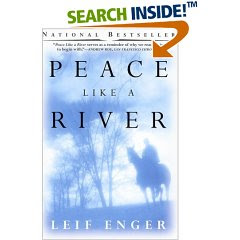
Peace Like A River


As kids we were all told, on some nice Summer day, to get outside and play. Summers were endless weekends spent poolside, or doing outdoor chores, so staying inside on any given day to read and live someone else's adventure never seemed exactly like punishment. Twenty years later sitting at desks in offices, knowing it's a beautiful Tuesday and that there are still three days of work before the weekend, we have a little more appreciation for our parents' suggestions. However, reverting back to my 9 year old self, I spent the better part of a beautiful weekend day living with the Land's.
Peace Like a River is Leif Enger's first book, and tells the story of father Jeremiah Land, his eldest son Davy, his younger son Reuban (the narrator) and his young daughter Swede. The live in a small Minnesota town in the early 1960s, but the kids dream of the outlaws and the West of a century before. Before long, they are given a chance to play out every kid's dream: vindication for a bully's crime, a daring jailbreak, riding horseback in the Badlands and living to tell about being tailed by the FBI.
All the Lands are fleshed out and maintain traits and speech specific to their characters. Reuban's narration in the far future is believable while at the same time painting a picture of romantic nostagia. Swede's epic poem of Sunny Sundown parallels the Land's journey from Minnesota to the Badlands. Jeremiah is the heroic and sometimes miracle performing father, wanting to teach his children right from wrong while acknowledging there is often a fine line separating the two.
Peace Like a River seemed to take the best qualities from To Kill A Mockingbird and In Cold Blood, while maintaining the (sometimes) lightheartedness of The Adventures of Huckleberry Finn. I don't regret wasting a beautiful day reading this book.
Netflix rating 5/5 stars.

Monday, July 21, 2008

A Million Little Pieces


I'll be the first to admit those Oprah's Book Club stickers bug me. For awhile it was because I knew it meant the book was going to tell the story of incest or abuse with an amazing protaganist turn around by book's end (think The Lovely Bones). She started expanding her choices, including Faulkner and McCarthy, but still...her pushiness and cult following (ladies, really, does a multi-millionaire woman have so much in common with you, trying to pay off student loans while raising two kids and facing a home foreclosure?) irked me. I cheered when Jonathan Franzen rejected her and refused to be a guest on her show, and I cringed and rooted for James Frey when she publicly derided him.

Having not actually read A Million Little Pieces, I thought: now's the time, and why not compare it to Jonathan Franzen's book of essays, How To Be Alone (I'd read The Corrections years ago and loved it).

First up, A Million Little Pieces. Steph gives a nice synopsis here, so I won't go through all that. But honestly, I was disappointed. Maybe it was because it was hyped in so many ways-- before he was exposed, and after. I just didn't think the writing was that great. He capitalizes a lot of Things and is very repetative. I'm not sure if I was influenced by the fact I knew he had exxagerated and made up parts of his story, but I found a lot of it completely unbelievable, and was surprised so many people bought it, hook, line and sinker. It was all tied up very neatly and in fact read pretty well as a novel, save for the bad writing. I was captivated for sure, and won't become a drug addict anytime soon, so I guess in that regards it's successful. I give this book 3 netflix stars. And I recommend drinking gin and tonics while reading it, because it's kind of more kick ass that way.